
Direct Thermal Labeling for Fast, Cost-Effective Printing
How does direct thermal labeling work?
Direct thermal labeling creates an image by applying heat directly to specially coated, heat-sensitive label material. As the material passes beneath the printer’s thermal printhead, selected areas darken to create text, barcodes, numbers, or graphics. No ink, toner, or thermal transfer ribbon is required.
Removing the ribbon simplifies the printing process and reduces the number of consumables that need to be stocked or replaced. Businesses can print individual labels or batches as needed, making direct thermal a practical option for high-volume operations where labels only need to remain readable for a limited period.
Pro-Motion Industries can help match the printing method, label material, and equipment to your application rather than specifying more durability than the job requires.
What are the best applications for direct thermal labels?
Direct thermal works best for short-term identification in controlled environments. It is particularly useful when labels need to be printed quickly, scanned reliably, and used before prolonged exposure to heat, sunlight, abrasion, or harsh chemicals becomes a concern. Common applications include:
Shipping and carton labels
Direct thermal is widely used for shipping labels because the label usually only needs to remain readable while a package moves through fulfillment and delivery.
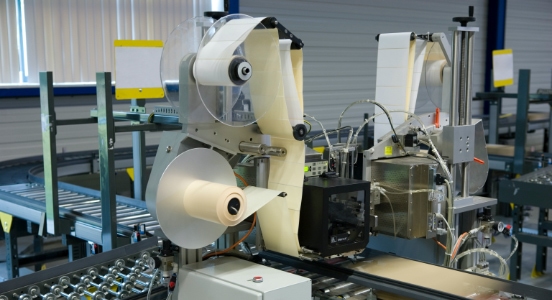
Businesses can print addresses, routing information, tracking numbers, and barcodes on demand without managing a separate ribbon supply. Direct thermal printing can also be incorporated into print-and-apply systems that automatically print variable information and apply the finished label to cartons. Pro-Motion offers systems that support direct thermal printing as part of automated labeling workflows.
Barcode and inventory labels
Direct thermal printers can produce one-dimensional and two-dimensional barcodes along with text and graphics. Thermal printing is well suited to barcode applications because it can produce clear edges and scannable images.
For inventory that turns over quickly or stays indoors, direct thermal can provide the required readability without the need for ink or ribbons.
Receipts, tickets, and identification
Receipts, event tickets, visitor badges, and similar materials are good candidates because they are only meant to last a short time.
Healthcare environments also use direct thermal technology for certain patient and visitor identification applications where the printed information is needed for a defined period rather than permanent identification.
Warehouse and fulfillment labeling
Warehouses can use direct thermal labels for picking, packing, temporary inventory identification, shipment preparation, and other workflows where labels move through the operation relatively quickly.
Businesses looking to automate application can pair suitable printers with automatic label applicators or integrated print-and-apply equipment. Pro-Motion carries industrial label applicators for different production requirements.
Why do businesses use direct thermal labeling?
Direct thermal printing combines simple operation with strong performance for the right applications.

Fewer printing supplies
No ribbon, ink cartridge, or toner is required. The heat-sensitive label material itself creates the image, reducing the number of consumables operators need to load and monitor.

Clear, scannable printing
Direct thermal can produce sharp text and barcodes for shipping, inventory, ticketing, and identification applications. It supports both individual and batch printing when information needs to be generated on demand.

Simple day-to-day operation
Eliminating the ribbon makes media changes more straightforward. Operators only need to manage the direct thermal label stock, which can simplify routine printing in busy warehouses, fulfillment centers, and other production environments.

Lower consumable requirements
Direct thermal can be economical for short-term applications because businesses are not purchasing both labels and ribbons. The best value comes when the application genuinely does not require the longer life and environmental resistance of thermal transfer printing.
How long do direct thermal labels last?
Direct thermal labels are intended primarily for temporary and short-term identification. Their actual lifespan varies considerably according to the label material, storage conditions, handling, and exposure to environmental factors.
The key question is not simply how long a direct thermal label can last. It is whether it will remain readable for the full period your application requires.
What can damage a direct thermal label?
Because the media remains heat-sensitive after printing, several conditions can shorten its useful life:
- Excessive heat
- Direct sunlight
- Strong fluorescent light
- Friction and abrasion
- Certain chemicals
- Prolonged environmental exposure
Too much heat or light can cause the material to darken, eventually reducing the contrast between the printed image and the rest of the label. Heavy abrasion can also affect readability. For products and equipment used outdoors, exposed to harsh production environments, or required to stay readable for years, thermal transfer labeling is usually the better choice.
What is the difference between direct thermal and thermal transfer labeling?
Both methods use a heated printhead, but they create the image differently.
- Direct thermal applies heat directly to specially coated label stock. The coating darkens where heat is applied, and no ribbon is needed.
- Thermal transfer heats a ribbon and transfers its wax- or resin-based coating onto the label, creating a more durable image and allowing printing on a broader selection of label materials.
| Consideration | Direct thermal | Thermal transfer |
|---|---|---|
| Ribbon required | No | Yes |
| Best use | Short-term labeling | Longer-term or demanding applications |
| Typical applications | Shipping, receipts, tickets, temporary barcodes | Product labels, assets, industrial identification |
| Heat and light resistance | More limited | Greater with the correct materials |
| Media options | Heat-sensitive media | Broad range of paper and synthetic materials |
| Consumables | Label stock only | Label stock plus ribbon |
When should you choose direct thermal?
Choose direct thermal when the label has a relatively short useful life, operates mainly indoors, and does not need to withstand substantial heat, sunlight, abrasion, or chemical exposure. Shipping labels are a common example. The label only needs to remain readable through fulfillment, transportation, and delivery. Paying for the additional durability of thermal transfer may offer little practical benefit.
When is thermal transfer the better option?
Thermal transfer is generally better when labels need to last longer or face more demanding conditions. Applications such as long-term product identification, asset tracking, outdoor labels, laboratory specimens, or labels exposed to chemicals and temperature extremes often require the additional material flexibility and durability thermal transfer can provide.
Can direct thermal printing work with automatic label applicators?
Yes. Direct thermal printers can be integrated into print-and-apply systems that generate variable information and apply the finished label automatically. A typical system prints the required barcode, shipping information, serial number, or product data as an item moves down the packaging line. Sensors detect the product or carton, and the printed label is then applied using a method such as tamp, blow-on, or wipe application.
Automating those steps can help businesses increase throughput, improve placement consistency, and reduce the amount of manual label handling required. Pro-Motion's equipment catalog includes automatic label applicators and print-and-apply equipment for different production environments, including systems that can integrate direct thermal printers.
What should you know about direct thermal labeling?
Not automatically. Moisture resistance depends on the specific direct thermal material, coating, adhesive, and application. If labels will face substantial moisture or harsh environmental exposure, the material should be evaluated carefully before production.
Direct thermal is generally not the preferred option for prolonged outdoor use. Heat and sunlight can darken or degrade the heat-sensitive media over time. Thermal transfer is typically more appropriate when outdoor durability is important.
Yes. Direct thermal printing can produce clear, scannable one-dimensional and two-dimensional barcodes for applications such as shipping, inventory, receipts, and temporary identification.
Excessive heat can activate areas of the heat-sensitive coating that were not originally printed. The label may darken and eventually become difficult to read or scan.
Start with the required lifespan and environment. Direct thermal is usually appropriate for short-lifespan applications in controlled conditions. Thermal transfer is a better fit when the image needs to remain readable for longer or withstand heat, sunlight, abrasion, chemicals, or demanding operating environments.
Need a simpler way to handle short-term labeling?
Pro-Motion Industries can help you determine whether direct thermal fits your application and identify the labels, printers, or automated equipment needed to keep production moving.